
When you need to measure nanoparticle size, picking the right method isn’t always straightforward. Your choice depends on factors like particle size, distribution nanoparticle size measurement, and the level of detail you require. Some techniques give you quick averages, while others reveal intricate shapes but demand more effort. Understanding these trade-offs helps you avoid misleading results and ensures your data really reflects what’s in your sample. But how do you decide which method fits your needs best?
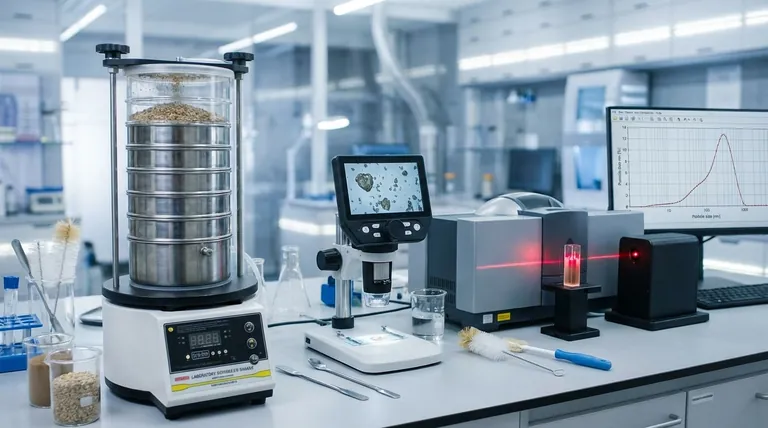
What Factors to Consider When Measuring Nanoparticle Size
When measuring nanoparticle size, you need to consider factors like particle shape, distribution, and the measurement environment. You’ll want to know if the particles are spherical, rod-shaped, or irregular, as this affects how size is interpreted.
Also, consider if the sample is uniform or has a broad distribution of sizes—this impacts the accuracy of your measurement. The environment plays a role too: temperature Lab Alliance, solvent type, and concentration can change particle behavior or cause aggregation.
You should pick a method suited to your particles’ characteristics and the conditions they’re in. By keeping these factors in mind, you’ll gain a clearer, more reliable understanding of nanoparticle size, giving you the freedom to make informed decisions in your work or research.
How Dynamic Light Scattering Works and When to Use It
Although measuring nanoparticle size can be challenging, Dynamic Light Scattering (DLS) offers a straightforward approach by analyzing how particles scatter light as they move in a fluid.
When you shine a laser through your sample, particles constantly jostle due to Brownian motion, causing fluctuations in the scattered light intensity. DLS measures these fluctuations to calculate the diffusion rate, which directly relates to particle size through the Stokes-Einstein equation.
This technique lets you quickly get average size and size distribution without complex prep.
You’ll find DLS especially useful for particles ranging from a few nanometers to about a micron in liquid suspension. It’s ideal when you want fast, non-destructive sizing and can tolerate some polydispersity in your sample.
When to Choose Electron Microscopy for Detailed Sizing
Dynamic Light Scattering gives you quick and convenient size estimates, but it falls short if you need detailed images or exact morphology of nanoparticles. That’s when electron microscopy (EM) steps in.
You should choose EM if you want high-resolution visuals that reveal shape, size distribution, and surface structures with nanometer precision. It’s perfect when your work demands exact measurements or when particles are complex and heterogeneous.
Unlike other methods, EM lets you directly observe individual nanoparticles instead of relying on indirect signals. Keep in mind, though, EM requires more preparation and expertise, but the freedom to see your particles clearly often outweighs that.
When accuracy and visual detail matter most, electron microscopy gives you the control and insight you need.

Comparing Nanoparticle Sizing Techniques by Accuracy and Range
Choosing the right nanoparticle sizing technique depends largely on the accuracy you need and the size range you want to measure.
If you’re after high precision for particles below 100 nm, electron microscopy offers unmatched detail but demands more time and expertise. Dynamic light scattering (DLS) suits you if you want quick averages across a broad size range, though it struggles with polydisperse samples.
Nanoparticle tracking analysis (NTA) provides size distribution and concentration with decent accuracy, ideal if you need both but within a narrower size window.
Techniques like atomic force microscopy (AFM) give surface topology and size but cover smaller sample areas.
Ultimately, pick a method balancing your precision needs and the particle sizes involved to keep your measurements meaningful and efficient.
Tips for Preparing Samples to Get Reliable Size Measurements
When preparing your samples for nanoparticle size measurement, proper handling is key to obtaining reliable results.
You want your data to reflect the true nature of your nanoparticles, not artifacts from poor prep.
Keep your process simple but effective, and avoid common pitfalls that can skew measurements.
Here are some tips to help you get it right:
- Use clean, contamination-free containers to avoid interference.
- Dilute samples properly to prevent aggregation or multiple scattering.
- Sonicate gently to disperse particles without breaking them.
- Avoid introducing air bubbles that can distort readings.
- Prepare fresh samples or store them under controlled conditions to maintain stability.
Conclusion
When measuring nanoparticle size, you need to match the technique to your sample and goals. Use dynamic light scattering for quick, average sizes in well-dispersed samples, but switch to electron microscopy if you want detailed, individual particle info. Consider other methods like nanoparticle tracking analysis or AFM depending on your needs. Always prepare your samples carefully, control concentration, and environment to get accurate, reliable results every time. Choosing wisely saves you time and improves your data quality.